The Strategy Tax: Why Every Acquisition Tells You What Leaders Couldn't Say
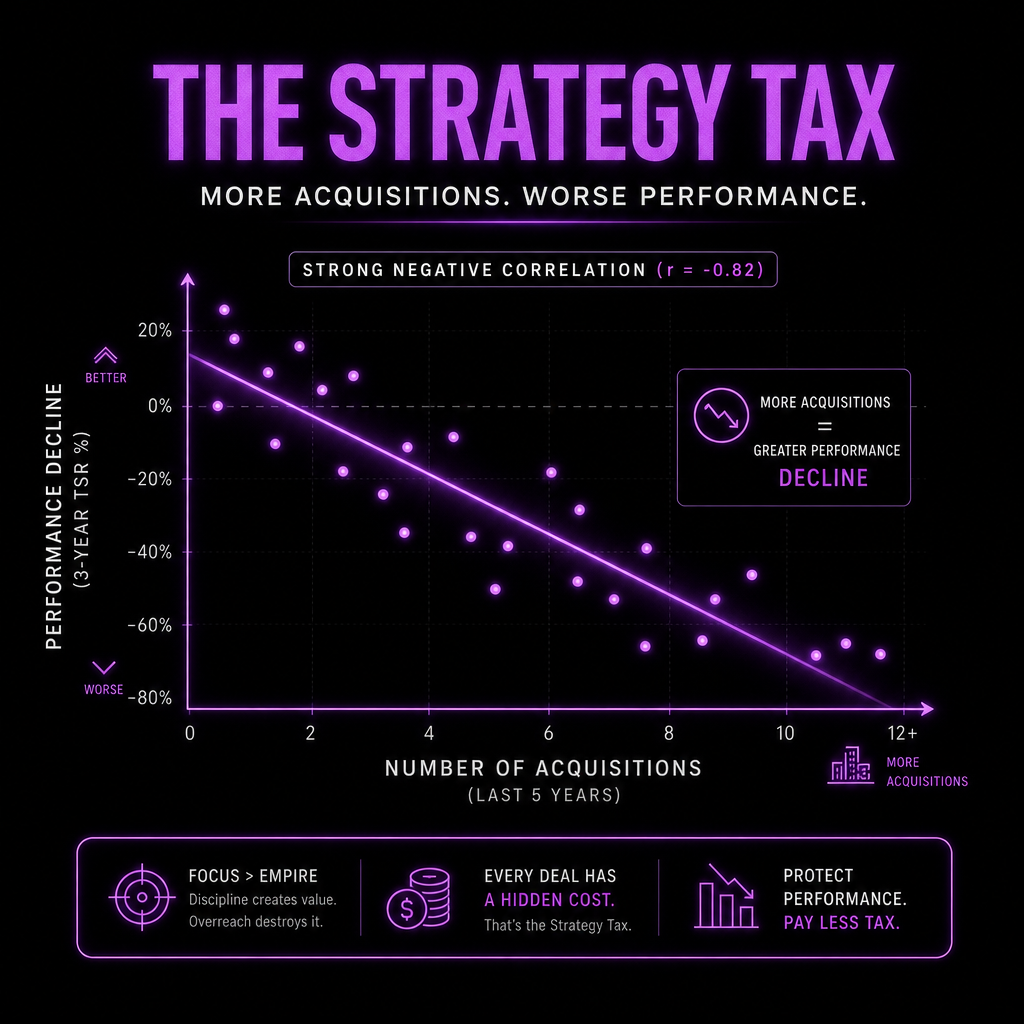
When companies can't articulate where they're going, they buy the path instead — and pay for it twice.
Brixmor and Everview are acquiring Slate Grocery REIT for $2.3 billion. Concurrent acquired Spire Investment Partners, reaching $28.6 billion in assets under management. Capitolis bought eSecLending for $200 million in cash. A Sarasota tape manufacturer picked up an Iowa shrink film maker. The Winooski Valley Park District acquired Charlie's Boathouse property.
In a single news cycle, five organizations across completely different sectors made the same strategic bet: that buying was faster than building, that external assets were clearer than internal direction, that writing a check was easier than writing a strategy.
They're probably right. And that's the problem.
Acquisitions aren't inherently strategic failures. But when I see this volume of M&A activity compressed into such a short window, I recognize a pattern I've watched play out across two decades of transformation work: organizations outsourcing strategic clarity. When leadership can't articulate a clear path forward, they acquire one. When teams can't align on priorities, they buy prioritization through integration. When digital transformation stalls, they purchase digital capabilities wholesale.
The market calls this growth. I call it the strategy tax.
The Articulation Gap
Strategy development has always been hard. Strategy articulation — the ability to translate direction into decisions that cascade through an organization — is harder still.
Watch what happens when strategic articulation breaks down. You get two signals, and they usually arrive within months of each other.
First signal: aggressive M&A activity that feels reactive rather than directional. Concurrent didn't just acquire Spire Investment Partners. They publicized reaching $28.6 billion in AUM — a scale metric that suggests the acquisition was about size, not capability. Capitolis paid $200 million in cash for eSecLending. Cash deals signal urgency. They say: we need this now, we'll figure out why later.
Second signal: class action lawsuits alleging securities fraud. AppLovin Corporation faces a lead plaintiff deadline of November 16, 2026. Dick's Sporting Goods has a deadline of November 3, 2026. The M&A Class Action Firm launched inquiries into multiple companies simultaneously.
These aren't causally linked. But they share a root condition: when leadership can't clearly articulate strategy to their own teams, they certainly can't articulate it to their investors. The gap between what was promised and what was delivered grows until someone lawyers up.
When leadership can't articulate a clear path forward, they acquire one. When teams can't align on priorities, they buy prioritization through integration.
The Culture Consequence
An OpenAI safety employee resigned, claiming the company's culture is broken. That single sentence tells you more about strategic misalignment than any earnings call.
Culture doesn't break from bad catering or aggressive deadlines. Culture breaks when people inside an organization can no longer see the connection between daily decisions and stated direction. When the strategy isn't articulable, it isn't actionable. When it isn't actionable, it isn't real.
I've rebuilt PMOs for organizations coming out of failed transformations. The pattern is consistent: leadership had a strategy deck, usually expensive and beautiful. They had transformation roadmaps, often detailed and color-coded. What they didn't have was a way to translate quarterly objectives into daily decisions for a product manager in Melbourne, a service designer in Manchester, or a safety researcher in San Francisco.
The articulation gap isn't about communication skills. It's about strategic coherence. If you can't explain your strategy simply enough that a mid-level employee can use it to prioritize their Tuesday afternoon, you don't have a strategy. You have a slide deck.
When that gap persists, talented people leave. They claim culture problems because culture is the experience of strategic incoherence at the human level. The OpenAI resignation isn't an HR issue. It's a strategy articulation failure that manifested as a culture complaint.
The Integration Illusion
Here's what happens after the acquisition press release:
Two technology stacks that need to merge. Two teams with different workflows, different tools, different definitions of what "done" means. Two PMOs with incompatible governance frameworks. Two cultures that were supposedly "aligned" during due diligence.
Integration reveals what due diligence couldn't: whether the acquiring organization had clear enough strategy to absorb new capabilities. Brixmor and Everview are acquiring a $2.3 billion REIT. That's not a tuck-in acquisition. That's a strategic bet that both organizations can articulate a unified vision for grocery-anchored retail, align their operational models, and execute a combined portfolio strategy.
Can they?
The antitrust lawsuit against Mission and HCA hit a roadblock. Antitrust scrutiny happens when market consolidation outpaces strategic differentiation. When regulators can't see how an acquisition serves anyone beyond the acquirer's shareholders, they look closer. The roadblock isn't about legal technicalities. It's about strategic justification.
I've led post-merger integration workstreams for multi-million dollar software implementations. The technical integration is straightforward. The strategic integration is where deals fall apart. If the acquiring company couldn't articulate its digital transformation strategy before the acquisition, buying a digital-native company doesn't fix that. It just means two organizations are now confused together.
Digiconus launched in Australia to deliver digital marketing and technology solutions to businesses. That's the counter-signal: organic build. Someone decided they could articulate a clear enough value proposition to enter a competitive market without acquiring existing players. They're betting on strategic clarity over acquired scale.
That bet is rarer than it should be.
The Advertising Week Signal
Digiday published a guide to what's in and out for Advertising Week NY 2026. Industry trend pieces are usually forgettable. This one matters because it reveals how quickly strategic consensus shifts.
Whatever is "out" for Advertising Week 2026 was probably "in" for Advertising Week 2025. That's a 12-month strategy horizon. For organizations executing three-year transformation roadmaps, that pace of change is a problem.
The strategy articulation challenge isn't just internal alignment. It's temporal alignment. Can you articulate a strategy that's stable enough to guide multi-year transformation initiatives but flexible enough to adapt when industry consensus shifts annually?
The organizations that handle this well separate strategic intent from tactical execution. Intent stays stable: we're building customer intelligence capabilities, we're automating service delivery, we're establishing data infrastructure. Tactics shift with the market: the specific martech stack changes, the automation platform evolves, the data warehouse migrates.
The organizations that handle this poorly lock strategy to tactics. They commit to specific technologies, specific platforms, specific partnerships — and then wonder why they're stuck when the market moves. Or they acquire their way out of the commitment, paying the strategy tax again.
The Portfolio Question
Project and portfolio management exists to operationalize strategy. When strategy isn't clearly articulated, PPM becomes political.
Which projects get funded? The ones with the loudest executive sponsor. Which initiatives get priority? The ones tied to recent acquisitions. Which transformation workstreams get resources? The ones connected to whoever won the last leadership offsite.
I've set up PMO practices for organizations where portfolio prioritization was a blood sport. Not because resources were scarce — resources are always scarce. Because strategic direction was ambiguous. Without clear articulation of where we're going and why, every portfolio decision is a bet on someone's interpretation of leadership intent.
The Winooski Valley Park District acquired Charlie's Boathouse property. That's a public sector acquisition with presumably clear strategic intent: expand park access, increase public amenities, serve community need. The business case probably took months. The strategic justification was probably straightforward.
Private sector acquisitions worth hundreds of millions or billions should have equally clear justification. The fact that securities fraud lawsuits and M&A class action inquiries are routine suggests they often don't.
When portfolio management works, it's because strategy articulation works first. Every project ties to a strategic objective. Every initiative maps to a business outcome. Every transformation workstream connects to a capability gap. The PMO can prioritize because leadership has already clarified.
When portfolio management fails, it's usually because someone is trying to manage a portfolio in service of a strategy that wasn't clearly articulated in the first place.
Building the Articulation Muscle
The strategy tax compounds. You pay once when you acquire instead of build. You pay again during integration when strategic misalignment surfaces. You pay a third time when the acquisition doesn't deliver the growth you promised investors and the lawsuits start.
There's an alternative path, but it requires confronting an uncomfortable truth: you might not have a strategy. You might have strategic intent. You might have strategic aspirations. You might have a strategy consultant's deliverable from 18 months ago. But if you can't articulate your strategy clearly enough that decisions align without executive intervention, you don't have a strategy yet.
Building that articulation muscle starts with testing. Take your current strategy — whatever document or deck represents it — and give it to a project manager three levels down. Ask them to use it to prioritize next quarter's work. If they can't, your strategy isn't articulated.
Take the same strategy and ask your service design team to use it to evaluate which customer journeys to automate first. If they need to escalate the decision, your strategy isn't articulated.
Take it to your PMO and ask them to use it to score your portfolio. If they need to invent scoring criteria because your strategy doesn't provide them, your strategy isn't articulated.
The organizations I've worked with that transform successfully — public sector and private, startups and enterprises — share one characteristic: their leadership can articulate strategy at multiple altitudes. They can explain the vision in a board meeting, translate it to objectives in a leadership offsite, convert it to decision criteria in a portfolio review, and express it as daily priorities in a team standup.
That articulation work is harder than writing a check for an acquisition. It's less flashy than announcing a $2.3 billion deal or reaching $28.6 billion in AUM. It doesn't generate press releases.
But it's the only thing that makes transformation possible. Because transformation isn't about acquiring new capabilities. It's about directing existing capabilities toward a clearly articulated future state. If you can't articulate where you're going, it doesn't matter how much capability you buy. You're just moving faster in no particular direction.
The organizations that avoid the strategy tax build articulation into their cadence. Strategy isn't a once-a-year offsite output. It's a continuous translation process: from vision to objectives, objectives to initiatives, initiatives to projects, projects to tasks, tasks to decisions.
Every acquisition is an articulation test. If you can explain how this purchase advances your stated strategy, connects to your transformation roadmap, and accelerates specific capability gaps — and if everyone three levels down can explain it too — then you've earned the M&A.
If you can't, you're paying the tax.
The news cycle will fill with more acquisitions. Some will succeed. Some will become case studies in integration failure and securities litigation. The difference won't be deal size or sector or timing.
The difference will be whether leadership could articulate why before they signed.