Why Telcos Are Building Data Moats While OpenAI Builds Agent Swarms
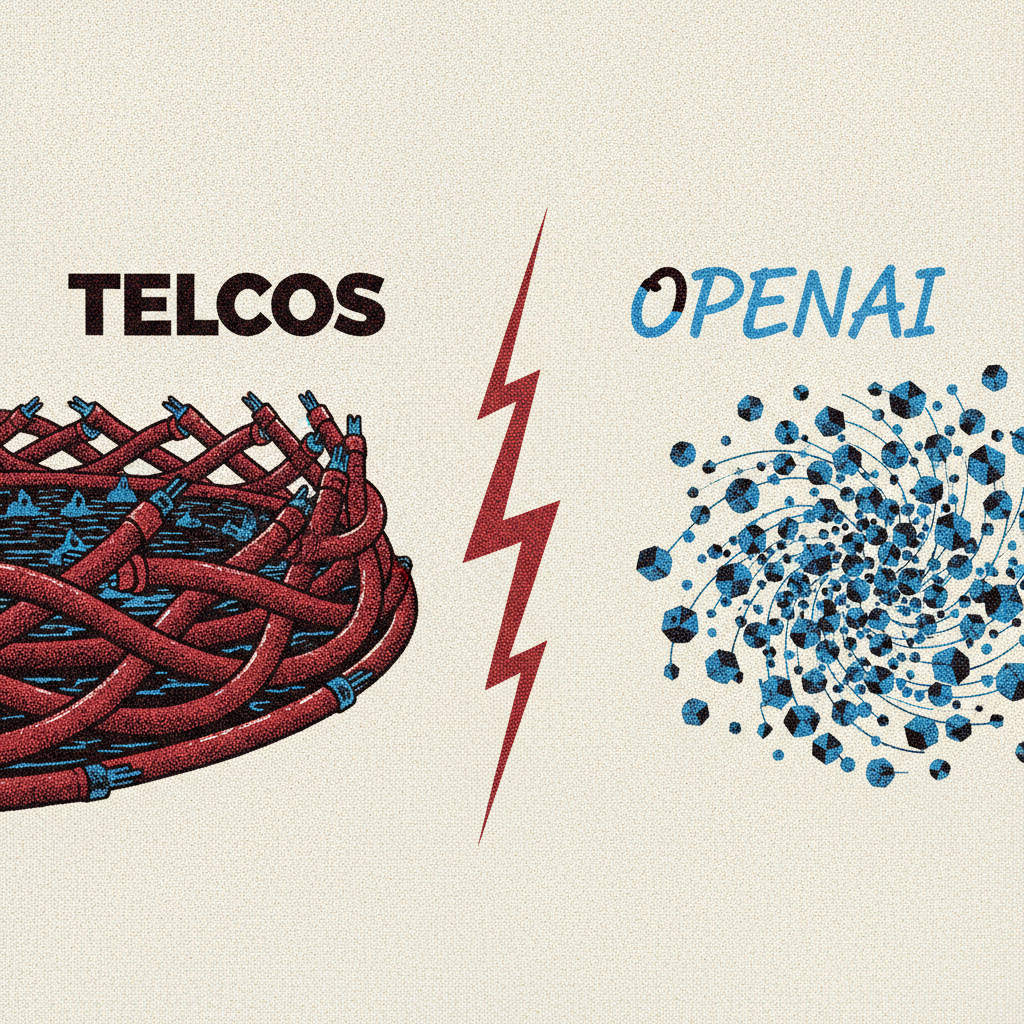
The infrastructure war nobody's talking about: regulated networks vs. frontier AI, and the $1.2T gap in between.
# Why Telcos Are Building Data Moats While OpenAI Builds Agent Swarms
Vodafone just announced it's testing 50G PON technology that can deliver 8 Gbps broadband to consumers. The Philippines regulator fined three mobile operators for failing to meet broadband quality commitments. OpenAI published a paper on disrupting coordinated model-distillation campaigns—essentially, catching people who steal their models by training smaller copies.
Three stories, same week. No obvious connection.
Except there is one, and it explains why the next phase of AI deployment won't look like the last five years of cloud migration. The through-line: infrastructure control determines who captures value in the AI economy, and regulated telcos are accidentally sitting on the most valuable training grounds for agentic AI.
We're watching two parallel build-outs that will collide within 18 months. Telcos are racing to own the last-mile pipe—faster, fatter, more reliable. Frontier labs like OpenAI are racing to own the reasoning layer—agents that book, buy, negotiate, decide. The collision point? The 2.3 billion consumers in emerging markets who need both, trust neither, and represent the largest untapped revenue pool in digital services.
The Invisible Subsidy: Why Regulators Are Paying for AI's Future Dataset
The Philippines story is boring on its face. Three operators got fined for substandard broadband. Happens every quarter somewhere.
But zoom out. Regulators globally—ACMA in Australia is running public consultations on stronger telco consumer protections right now—are forcing operators to hit quality benchmarks, publish SLAs, remediate failures. They're essentially mandating that telcos create high-fidelity, timestamped records of network performance, customer complaints, resolution workflows, and service delivery.
That's not compliance paperwork. That's labeled training data for operations AI.
Every time a regulator fines an operator for missed broadband speeds, the operator has to instrument more of the network, track more variables, close more feedback loops. The penalty structure creates an incentive to build the exact monitoring and intervention systems that later become the substrate for autonomous network optimization.
Vodafone's 50G PON tests and its new Pro 4 fibre and 5G Broadband plans aren't just capacity upgrades. They're bets that whoever owns the densest sensor grid—every ONT, every cell site, every customer premise—can train the best predictive models for quality-of-service management. And those models, once trained, become IP that's nearly impossible to replicate without access to the same regulated footprint.
Regulators think they're protecting consumers. They are. But they're also subsidizing the creation of proprietary datasets that incumbents will use to defend their position against hyperscalers who have no physical network to learn from.
The Agent Wars Start Where the Pipe Ends
OpenAI's announcement about disrupting a coordinated model-distillation campaign tells you everything you need to know about where frontier labs see the threat.
Model distillation is when you use a large, expensive model to train a smaller, cheaper one—effectively copying the intelligence without paying for the compute. OpenAI's detection method means they're worried enough about IP leakage to publish adversarial defenses.
Why now? Because the unit of competition just shifted from models to agents.
WIRED reported that the battle to be your personal AI agent is here. OpenAI wrote about helping small businesses put AI to work and introduced what TechCrunch called a "Jev clone"—a reference to internal tooling that helps the lab manage swarming agents. Translation: OpenAI is moving from selling API calls to selling persistent, stateful reasoning systems that live inside your workflow.
That changes the value equation. An API call is a commodity. An agent that knows your vendor list, payment history, seasonal demand patterns, and contract renewal dates is a moat.
But agents need data to be useful. And in regulated markets—telecom, fintech, healthcare—the richest behavioral data sits behind API walls controlled by incumbents.
Infrastructure control determines who captures value in the AI economy, and regulated telcos are accidentally sitting on the most valuable training grounds for agentic AI.
Telcos have call detail records, location data, billing cycles, usage patterns, churn signals. Fintechs have transaction streams, merchant relationships, credit behavior, fraud patterns. OpenAI has transformer weights and Python SDKs.
Who wins when agents need to negotiate your mobile plan, dispute a charge, or optimize your working capital? The lab that built the best LLM, or the operator that controls the account ledger?
The Fintech Layer: Where Code Meets Capital Structure
Mercury—a digital banking platform for startups—just debuted accounting software integrated directly into its core product. Not a partnership. Not an API bolt-on. Native accounting, built into the ledger.
That's the playbook. Collapse the stack. Own more of the value chain vertically so that AI can operate across it horizontally.
Traditional accounting software treats the bank as an external system. You export a CSV, reconcile in QuickBooks, hope nothing breaks. Mercury is saying: if we own both the transaction rail and the categorization logic, we can train models that auto-close books, flag anomalies, and suggest cash management moves—all without leaving the platform.
This is why SuperApps work in emerging markets and struggle in the West. In markets where infrastructure is fragmented and trust is expensive, the platform that bundles the most services wins—because switching costs compound and data network effects kick in faster.
But there's a trap. The Straits Times reported that over 23,500 Simba customers in Singapore had personal information leaked in a data breach. Simba is a mobile virtual network operator—essentially a telco reseller.
When you collapse the stack, you also collapse the blast radius. One breach exposes everything: identity, payment, location, usage. That's fine when you're Mercury serving venture-backed startups who self-selected for risk tolerance. It's catastrophic when you're a telco or fintech serving 10 million users in a market where regulatory penalties are calibrated to GDP per capita.
This is the underpriced risk in the "AI-first" fintech narrative. You can't deploy agentic AI at scale in regulated markets without solving for compartmentalized data access—agents that can act on your behalf without seeing everything about you. The labs building general-purpose agents don't have that muscle. The telcos and banks do, because they've spent 20 years navigating GDPR, PCI-DSS, and local data residency rules.
The Talent Dislocation Nobody Wants to Name
The Economic Times published a report on a two-tier workforce complicating talent development in financial services. The headline undersells the problem.
What's actually happening: financial services firms are splitting into two castes. One tier builds and operates AI systems. The other tier does manual work that hasn't been automated yet—but will be. The gap between the two is widening, and the upgrade path from tier two to tier one is breaking down.
This isn't a training problem. It's an architectural problem.
When Mercury builds native accounting into its banking platform, it eliminates the need for a whole category of reconciliation work. When OpenAI offers small businesses tools to "put AI to work," it's targeting the $47B spend on back-office SaaS that employs millions of people in tier-two roles.
Telcos face the same split. RCR Wireless covered the "supercycle fever" gripping the industry—the idea that 5G device upgrades and fiber deployments will drive a multi-year revenue boom. But the operational reality is that as networks get faster and more software-defined, the labor model shifts. You need fewer field techs and more data engineers. Fewer call center agents and more prompt engineers tuning conversational AI.
The upgrade path used to be clear: start in customer service, move to operations, then management. But if customer service is handled by an LLM fine-tuned on your CRM data, and operations is handled by automated provisioning systems, where do people enter the pyramid?
This is the externality that AI-native companies don't want to price in. When you collapse the stack and automate the middle, you orphan a workforce that can't retrain fast enough to stay relevant. That creates political risk. And in regulated markets, political risk becomes regulatory risk, which becomes cost of capital risk.
What the Collision Looks Like
Here's the scenario that plays out over the next 18 months:
Phase 1 (now): Telcos and fintechs invest in infrastructure—faster pipes, better APIs, integrated platforms. They're optimizing for throughput and margin, not for AI readiness. But in the process, they're creating the datasets and access controls that agents will need to operate at scale.
Phase 2 (6–12 months): Frontier labs start offering agent-as-a-service products targeting enterprises. OpenAI's small business tools, Anthropic's enterprise API, Google's Vertex AI agents. These products will be model-agnostic, workflow-aware, and designed to plug into existing SaaS stacks.
Phase 3 (12–18 months): The first major integration deals get announced. A telco in Southeast Asia partners with a frontier lab to deploy AI agents for customer retention. A digital bank in India integrates agent-based credit underwriting. These aren't API partnerships—they're co-development deals where the incumbent provides data and distribution, and the lab provides reasoning capability.
Phase 4 (18+ months): Regulation catches up. A data breach involving an AI agent that had over-permissioned access triggers a regulatory review. New frameworks emerge around "agent accountability"—who's liable when an LLM-powered system makes a decision that violates fair lending laws or data residency rules?
The companies that win this transition will be the ones that recognize the collision early and position themselves as the integration layer—the platform that lets agents operate across telecom, fintech, and commerce without exposing raw customer data to the model provider.
That's not a tech problem. That's a commercial structuring problem. It requires contracts, SLAs, audit trails, and economic models that split value between the infrastructure owner and the intelligence provider.
What to Do About It
If you're running commercial, product, or AI strategy at a telco or fintech in an emerging market, here's the specific play:
1. Audit your data exhaust. What operational datasets are you generating as a byproduct of compliance and service delivery? Call transcripts, resolution workflows, billing disputes, fraud alerts. These are training sets for vertical AI. If you're not cataloging and versioning them now, you're leaving IP on the table.
2. Build API wrappers with agent interfaces in mind. Your current APIs were designed for developers writing code. Agents don't write code—they call functions based on natural language intent. That means you need endpoints that accept higher-level instructions ("pause service for 30 days") instead of low-level primitives ("update subscription status to paused with end_date parameter").
3. Map your liability surface. When an agent acts on behalf of a customer, who's responsible if it screws up? You need legal and compliance frameworks that define accountability before you integrate third-party reasoning systems. The lab won't take liability for business logic—they'll disclaim it in the ToS. That means you own the outcome.
4. Test co-development partnerships now, at small scale. Pick one high-frequency, low-risk workflow—password resets, plan recommendations, bill explanations—and build a pilot with a frontier lab or open-source agent framework. Learn how to structure the data-sharing agreement, the performance SLA, and the economic split. Do it while the stakes are low.
5. Train your commercial team to price AI-assisted services differently. When you sell broadband, you price on speed and cap. When you sell broadband + AI-assisted troubleshooting + proactive network optimization, you're selling uptime and peace of mind. That's a different value prop, and it commands a different margin structure.
The window to position for this is narrow. Once the first major telco-lab integration gets announced, every competitor will rush to catch up, and you'll be negotiating from a position of weakness.
The companies that move now—while the labs still need data and distribution more than telcos need models—will write the terms. Everyone else will be a customer.
The question isn't whether AI agents will operate across your infrastructure. The question is whether you'll own the integration layer, or rent it.