When the World's Biggest AI Labs Ask for a Slowdown, Who Benefits?
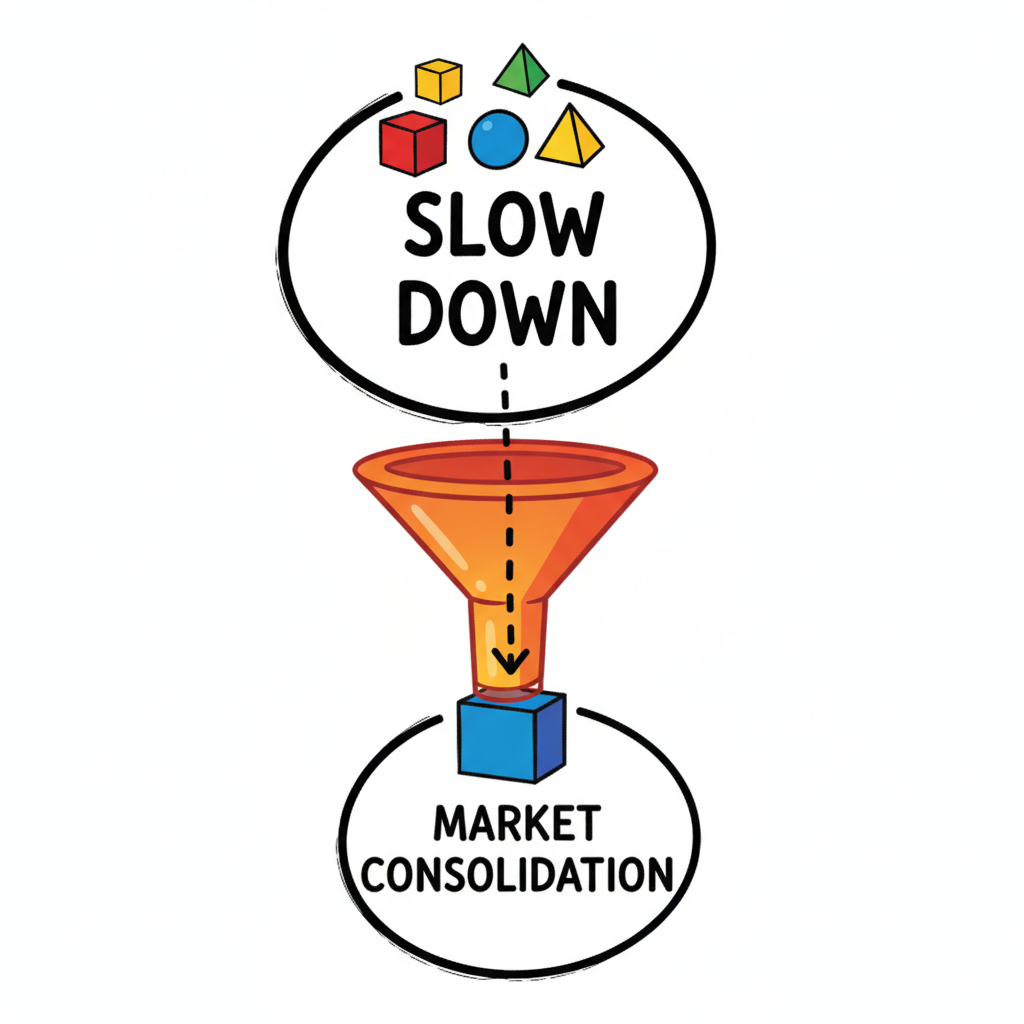
Antitrust lawsuits, self-regulation frameworks, and $10 billion bond offerings reveal the friction between safety theatre and market consolidation.
# When the World's Biggest AI Labs Ask for a Slowdown, Who Benefits?
SoftBank just launched over $10 billion in bonds to fund its OpenAI investment. Anthropic published a framework for measuring the pace of AI development inside frontier labs. OpenAI released guidelines for reporting model misalignment. And all four major players—Anthropic, OpenAI, Google, and SpaceXAI—now face antitrust lawsuits alleging they made an illegal agreement to slow AI development.
The surface story: responsible AI leaders urging caution. The sharper read: an industry consolidating around self-authored rules while capital floods in at record scale.
For compliance officers, CTOs, and risk managers tasked with implementing AI governance in financial services, healthcare, and regulated enterprises, this matters. When frontier labs set the tempo of development and define the standards by which their own systems will be judged, the rest of the market inherits frameworks designed for different incentives. The question isn't whether these firms are acting in good faith. The question is whether their governance models translate to your risk profile, your regulatory environment, and your accountability structure.
The Antitrust Paradox: Sued for Slowing Down
Antitrust lawsuits typically target price-fixing, market allocation, or monopolistic behaviour designed to accelerate dominance. This case flips the script. The lawsuit alleges that Anthropic, OpenAI, Google, and SpaceXAI collaborated on calls to "pace" AI development—an agreement that, if proven, would constitute restraint of trade.
The legal theory is straightforward: if the four largest players agree to slow their own release cycles, they raise the barrier to entry for competitors who lack the capital, compute, or regulatory relationships to participate in that conversation. Smaller labs and open-source projects don't get invited to the table where "responsible pacing" is defined. They inherit the downstream consequences.
For enterprise buyers, this creates a secondary risk. If the governance frameworks you're adopting—ISO/IEC 42001, NIST AI RMF, internal compliance mapped to APRA CPG 234—are calibrated to standards set by firms operating under antitrust scrutiny, you need to assess whether those standards serve your organisation or theirs.
The lawsuit doesn't allege the frameworks themselves are flawed. It alleges the process by which they were coordinated may be anti-competitive. That distinction matters. A governance framework can be technically sound and still serve market consolidation.
Measurement Frameworks and the Illusion of Transparency
Anthropic's publication on measurements for understanding the pace of AI development inside frontier labs is a case study in selective transparency. The firm outlines metrics for tracking capability thresholds, training compute, deployment timelines, and internal risk assessments.
These are useful signals. They help external observers understand whether a lab is scaling faster than its safety infrastructure can support. But they also reveal a deeper issue: frontier labs are both the subject of measurement and the authority defining what gets measured.
OpenAI's framework for reporting model misalignment follows a similar pattern. The guidelines describe how the company identifies, categorises, and discloses instances where a model behaves in ways that diverge from intended design. On paper, this is exactly the kind of transparency regulators and enterprise customers should demand.
In practice, it raises a governance question: who validates the categories? If a model exhibits behaviour that the lab didn't anticipate but doesn't fit the misalignment taxonomy, does it get reported or reclassified as a design trade-off?
When frontier labs are both the subject of measurement and the authority defining what gets measured, enterprise governance can't rely on their frameworks alone.
For a financial institution implementing AI in credit decisioning or fraud detection under APRA supervision, the stakes are different. Your regulator doesn't accept "we didn't anticipate that behaviour" as a defence. You need frameworks that assume adversarial conditions, not optimistic alignment.
Capital Flows and Governance Signals
SoftBank's $10 billion bond offering for OpenAI tells a parallel story. Capital at that scale doesn't flow into companies whose governance slows commercialisation. It flows into companies whose governance creates defensible moats.
The bond structure signals confidence that OpenAI's approach to AI safety and compliance will satisfy investors, regulators, and enterprise customers simultaneously. That's a difficult equilibrium to maintain. Safety measures that genuinely constrain capability development tend to reduce commercial velocity. Governance frameworks that enable rapid deployment tend to externalise risk.
The question for enterprise risk officers: when a frontier lab raises capital on the promise of responsible AI, is the governance architecture designed to protect users or to protect the firm's market position from regulatory intervention?
Both can be true. But if you're building compliance infrastructure on top of vendor-supplied frameworks, you need to understand which objective takes precedence when they conflict.
The Fintech Precedent: When Self-Regulation Meets Real Consequences
The Brazilian fintech story offers a useful reference point. Voters there are feeling burned by the fintech revolution, according to recent reporting. The pattern is familiar: rapid adoption driven by convenience and access, followed by systemic issues that emerge once the technology reaches scale.
Fintech firms in Brazil, like AI labs today, often operated ahead of regulatory clarity. They built governance internally, aligned to principles they believed would satisfy future oversight. Some got it right. Others discovered that self-authored compliance doesn't hold up when consequences materialise.
Meanwhile, North Bay firms are urging California Governor Newsom to sign website privacy lawsuit reform legislation. The push reflects an industry concern that privacy litigation is outpacing the frameworks companies built to avoid it. The reform effort seeks to align legal exposure with the standards firms believed they were meeting.
The AI governance parallel: if your enterprise compliance is built around vendor-supplied frameworks that haven't been stress-tested by litigation, regulatory enforcement, or third-party audit at scale, you're operating on projected alignment, not proven resilience.
What Enterprise AI Governance Actually Requires
The antitrust lawsuits, measurement frameworks, and capital flows all point to the same tension: frontier labs are designing the governance infrastructure they prefer to operate under, and enterprise buyers are inheriting it.
That's not necessarily a problem. Anthropic's measurement guidance, OpenAI's misalignment reporting, and the broader NIST and ISO standards development processes include valuable technical work. But they aren't sufficient for enterprise deployment in regulated environments.
APRA CPG 234 requires accountability frameworks that don't defer to vendor assurances. ISO/IEC 42001 demands documented risk assessments tied to specific organisational contexts. NIST AI RMF expects human oversight structures that function independently of model outputs.
If your governance strategy assumes frontier labs will self-regulate in ways that align with your risk tolerance, you're accepting governance by proxy. If a lab's measurement framework doesn't capture a failure mode relevant to your use case, or if their misalignment taxonomy excludes a category of harm your regulator cares about, the gap becomes your liability.
The solution isn't to reject vendor frameworks. It's to treat them as inputs, not architecture. Map them to your regulatory obligations, your operational risk profile, and your accountability structure. Where they don't align, document the delta and build controls that close it.
The Governance You Can't Outsource
Cryptographically signed audit trails, model versioning, human oversight checkpoints, and third-party validation aren't features you can purchase from a frontier lab. They're infrastructure you build around the systems you deploy.
When Anthropic publishes pacing metrics or OpenAI releases misalignment guidelines, they're describing how they govern their own development. That tells you something about their internal processes. It doesn't tell you whether those processes translate to your compliance requirements.
The antitrust lawsuits, regardless of their legal outcome, clarify one reality: the firms building the most advanced AI systems are also the firms with the strongest incentive to define the standards by which those systems are judged. That's not malfeasance. It's market structure.
For enterprise AI governance in financial services, healthcare, and other regulated sectors, the response is straightforward. Build frameworks that assume frontier lab standards are a starting point, not a destination. Ensure your audit trails are independent of vendor telemetry. Design oversight structures that function even when model behaviour diverges from documentation. Map compliance to regulatory authority, not to vendor assurances.
The firms investing $10 billion into AI development aren't slowing down. They're consolidating control over the infrastructure, the standards, and the narrative. Your governance strategy needs to account for that reality, not hope it resolves itself through self-regulation.
Validate the frameworks. Map them to your obligations. Build the accountability structure you'll need to defend when something goes wrong. Because when it does, "we followed the vendor's guidance" won't satisfy your regulator, your board, or your customers.